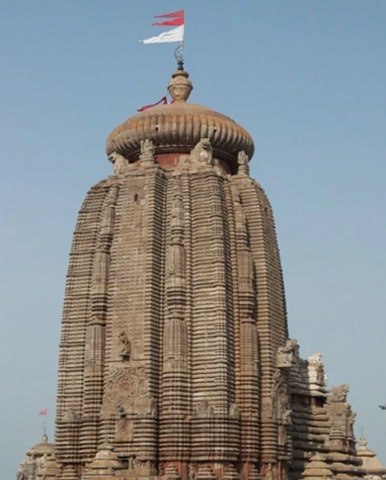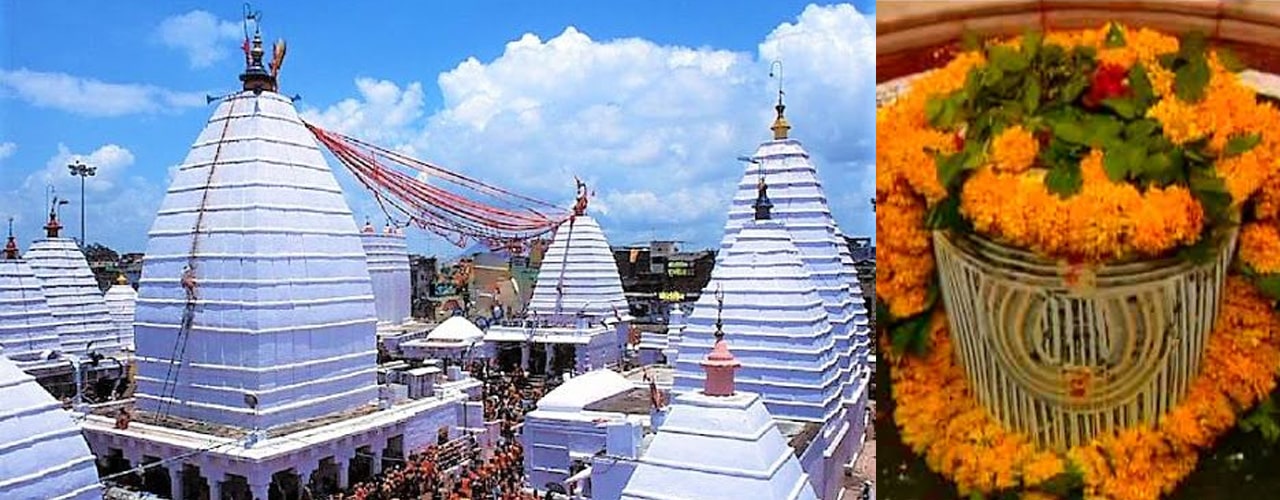
Baidyanath Temple, Deoghar
Vaidyanatha Jyotirlinga temple, also known as Baba Baidyanath dham and Baidyanath dham is one of the twelve Jyotirlingas, the most sacred abodes of Shiva. It is located in Deoghar in the Santhal Parganas division of the state of Jharkhand, India. It is a temple complex consisting of the main temple of Baba Baidyanath, where the Jyotirlinga is installed, and 21 other temples.
According to Hindu beliefs, the demon king Ravana worshipped Shiva at the current site of the temple to get the boons that he later used to wreak havoc in the world. Ravana offered his ten heads one after another to Shiva as a sacrifice. Pleased with this, Shiva descended to cure Ravana who was injured. As he acted as a doctor, he is referred to as Vaidhya ("doctor"). From this aspect of Shiva, the temple derives its name.
Kanwar Yatra (Devanagari: कांवड़ यात्रा) is an annual pilgrimage of devotees of Shiva, known as Kānvarias(कावड़िया) or "Bhole" (भोले) to Hindu pilgrimage places of Sultanganj in Bihar to fetch holy waters of Ganges River. Millions of participants gather sacred water from the Ganga and carry it across hundreds of miles to dispense as offerings in Baidyanath Temple in Jharkhand.
As per Shiv Mahapuran, once Brahma (the Hindu God of creation) and Vishnu (the Hindu God of preservation) had an argument in terms of supremacy of creation.To test them, Shiva pierced the three worlds as a huge endless pillar of light, the jyotirlinga. Vishnu and Brahma split their ways to downwards and upwards respectively to find the end of the light in either direction. Brahma lied that he found out the end, while Vishnu conceded his defeat. Shiva appeared as the second pillar of light and cursed Brahma that he would have no place in ceremonies while Vishnu would be worshipped till the end of eternity. The jyotirlinga is the supreme partless reality, out of which Shiva partly appears. The jyothirlinga shrines, thus are places where Shiva appeared as a fiery column of light.
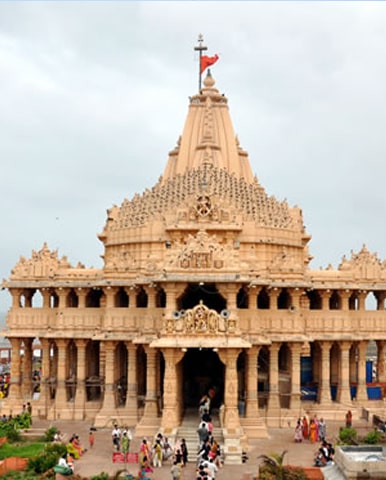
Originally there were believed to be 64 jyothirlingas while 12 of them are considered to be very auspicious and holy.Each of the twelve jyothirlinga sites take the name of the presiding deity - each considered different manifestation of Shiva.At all these sites, the primary image is lingam representing the beginningless and endless Stambha pillar, symbolizing the infinite nature of Shiva.The twelve jyothirlinga are Somnath in Gujarat, Mallikarjuna at Srisailam in Andhra Pradesh, Mahakaleswar at Ujjain in Madhya Pradesh, Omkareshwar in Madhya Pradesh, Kedarnath in Uttarakhand, Bhimashankar in Maharashtra, Viswanath at Varanasi in Uttar Pradesh, Triambakeshwar in Maharashtra, Vaidyanath Jyotirlinga at Parli, Maharashtra, Baidyanath at Deoghar in Jharkhand, Nageswar at Dwarka in Gujarat, Rameshwar at Rameswaram in Tamil Nadu and Ghushmeshwar at Maharashtra.
The Maa Parvathi temple is tied up with the main temple, with huge red sacred threads which is unique and worthy of reverence, showing the unity of Shiva and Shakti. According to the stories narrated in the Shiva Purana, the holy Baidyanath temple resembles the unity of souls and thus fits marriage for Hindus.
The nearest railway station is Jasidih railway station, which is 7 km from Vaidyanath temple. Jasidh is 311 km from Howrah/Sealdah on Patna route. On a normal day, the worshipping of Baidyanath Jyotirlingam begins at 4 AM. The temple doors open at this time. During 4:00am to 5:30 am, the Head priest worships with Shodashopachar. Locals also call it Sarkari Pooja. Then the devotees begin their worship of the Shivalinga. The most interesting tradition is that priests of the temple pour kuchcha Jal upon the lingam first, and later on, the pilgrims pour water and offer flowers and Bilva leaf, upon the lingam. The Puja rituals continue till 3.30 PM. After this, the temple doors are closed. In the evening at 6 PM the doors are opened again for devotees/ pilgrims and the process of worshipping begins again. At this time Shringar Puja takes place. The temple closes at 9:00 pm on a normal day, but during Holy Shravan month, the timings are extended. Unlike Somnath or Rameshwaram or Srisailam, here the devotees can get satisfaction by offering Abhishek themselves on Jyotirlinga. The pandas who perform different poojans for devotees are very important persons. The devotee can also buy Peda as prasad from Babadham. Peda is a local speciality of Deoghar. Babadham has a regular and well-maintained office to accept offerings and donations.
The Matsyapuran narrates the place as Arogya Baidyanathitee, the holy place where Shakti lives and assists Shiva in freeing people from incurable diseases. This whole area of Deoghar was under the rule of the Kings of Gidhaur who were much attached with this temple. Raja Bir Vikram Singh founded this princely state in 1266. In 1757 after the Battle of Plassey the officers of the East India Company paid their attention to this temple. An English man, Keating was sent to look at the administration of the temple. Mr. Keating, the first English collector of Birbhum, took interest in the administration of the temple. In 1788, under Mr. Keating's order Mr. Hesilrigg, his assistant, who was probably the first English man to visit the holy city, set out to supervise personally the collection of the pilgrim offerings and dues. Later, when Mr. Keating himself visited Babadham, he was convinced and forced to abandon his policy of direct interference. He handed over the full control of the temple to the hands of the high priest.
Source : Wikipedia
TrasnportBy Road: Deoghar is 16 Kms from Sarawan, 36 Kms from Sarath, 41 Kms from Jarmundi, 52 Kms from Chandmari, 52 Kms from Bengabad, 68 Kms from Deori, 70 Kms form Giridih, 132 Kms from Dhanbad, 148 Kms from Koderma, 278 Kms from Ranchi and is linked via Jharkhand State Road Transport Corporation Limited, West Bengal State Road Transport Corporation Limited and some private travel services.
By Train: The railway station is located in Baidyanath Dham at a distance of 7 Kms from Deoghar and is well connected with many major cities like New Delhi, Mumbai, Kolkata, Varanasi and Bhubaneswar etc.
By Air: The nearest Domestic Airport is Lok Nayak Jayaprakash Airport, Patna, located at a distance of 274 Kms from Deoghar. Patna has daily flights to many cities like Bangalore, Chennai, Delhi, Kolkata, Lucknow, Hyderabad, Mumbai, Ranchi, Bhopal, Ahmedabad, Goa and Vishakhapatnam.