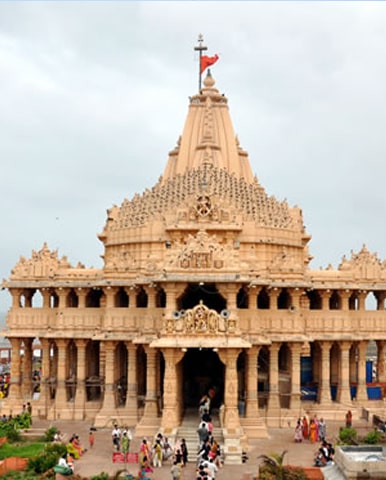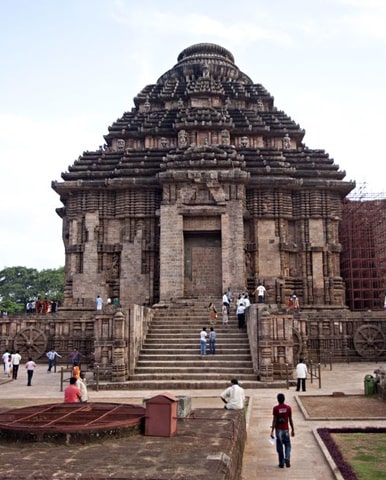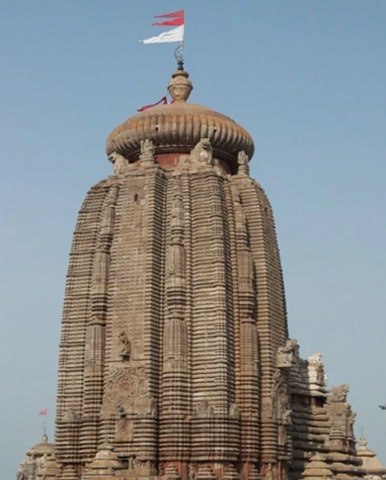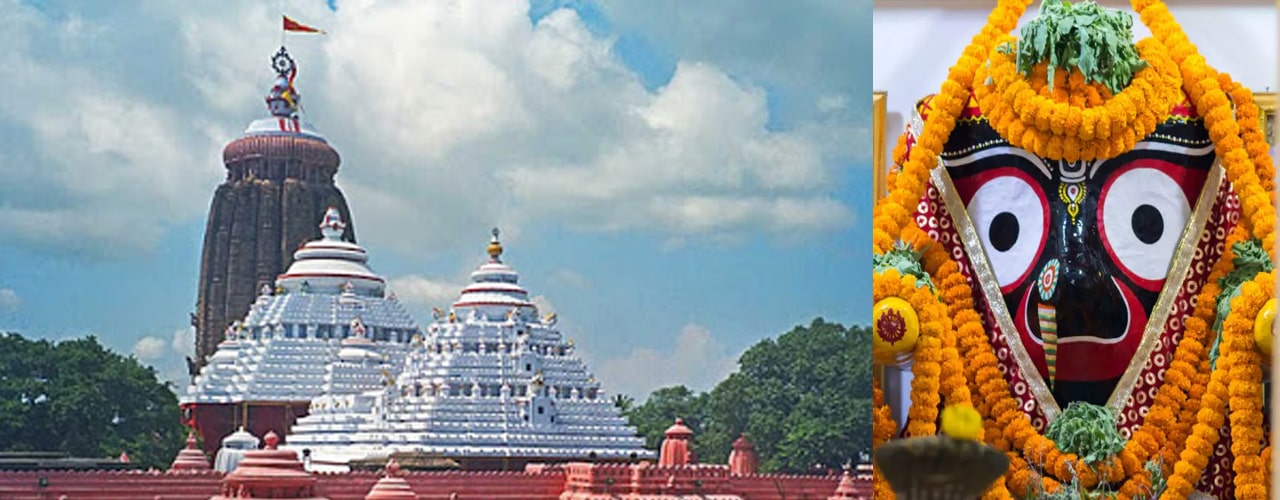
Shree Jagannath Temple, Puri
The Shree Jagannath Temple is an important Hindu temple dedicated to Jagannath, a form of Vishnu, in Puri in the state of Odisha on the eastern coast of India. The present temple was rebuilt from the 10th century onwards, on the site of an earlier temple, and begun by King Anantavarman Chodaganga Deva, first of the Eastern Ganga dynasty.
The Puri temple is famous for its annual Ratha yatra, or chariot festival, in which the three principal deities are pulled on huge and elaborately decorated temple cars. These gave their name to the English term 'Juggernaut'. Unlike the stone and metal icons found in most Hindu temples, the image of Jagannath is made of wood and is ceremoniously replaced every twelve or nineteen years by an exact replica.It is one of the Char Dham.
The temple is sacred to all Hindus and especially in those of the Vaishnava traditions. Many great Vaishnava saints, such as Ramanujacharya, Madhvacharya, Nimbarkacharya, Vallabhacharya and Ramananda were closely associated with the temple.Ramanuja established the Emar Mutt near the temple and Adi Shankaracharya established the Govardhana Mutt, which is the seat of one of the four Shankaracharyas. It is also of particular significance to the followers of the Gaudiya Vaishnavism whose founder Chaitanya Mahaprabhu, was attracted to the deity, Jagannath, and lived in Puri for many years.
The temple was built by the Ganga dynasty king Anantavarman Chodaganga in the 12th century CE, as suggested by the Kendupatna copper-plate inscription of his descendant Narasimhadeva II.Anantavarman was originally a Shaivite, and became a Vaishnavite sometime after he conquered the Utkala region (in which the temple is located) in 1112 CE. A 1134–1135 CE inscription records his donation to the temple. Therefore, the temple construction must have started sometime after 1112 CE.
According to a story in the temple chronicles, it was founded by Anangabhima-deva II: different chronicles variously mention the year of construction as 1196, 1197, 1205, 1216, or 1226.This suggests that the temple's construction was completed or that the temple was renovated during the reign of Anantavarman's son Anangabhima.The temple complex was further developed during the reigns of the subsequent kings, including those of the Ganga dynasty and the Suryvamshi (Gajapati) dynasty.
According to legend, the construction of the first Jagannath temple was commissioned by King Indradyumna, son of Bharata and Sunanda, and a Malava king, mentioned in the Mahabharata and the Puranas.
The legendary account as found in the Skanda-Purana, Brahma Purana and other Puranas and later Odia works state that Lord Jagannath was originally worshipped as Lord Neela Madhaba by a Savar king (tribal chief) named Viswavasu. Having heard about the deity, King Indradyumna sent a Brahmin priest, Vidyapati to locate the deity, who was worshipped secretly in a dense forest by Viswavasu. Vidyapati tried his best but could not locate the place. But at last he managed to marry Viswavasu's daughter Lalita. At repeated request of Vidyapti, Viswavasu took his son-in-law blind folded to a cave where Lord Neela Madhaba was worshipped.
Vidyapati was very intelligent. He dropped mustard seeds on the ground on the way. The seeds germinated after a few days, which enabled him to find out the cave later on. On hearing from him, King Indradyumna proceeded immediately to Odra desha (Odisha) on a pilgrimage to see and worship the Deity. But the deity had disappeared. The king was disappointed. The Deity was hidden in sand. The king was determined not to return without having a darshan of the deity and observed fast unto death at Mount Neela, Then a celestial voice cried 'thou shalt see him.' Afterward, the king performed a horse sacrifice and built a magnificent temple for Vishnu. Narasimha Murti brought by Narada was installed in the temple. During sleep, the king had a vision of Lord Jagannath. Also an astral voice directed him to receive the fragrant tree on the seashore and make idols out of it. Accordingly, the king got the image of Lord Jagannath, Balabhadra, Subhadra and Chakra Sudarshan made out of the wood of the divine tree and installed them in the temple.
Source : Wikipedia
TrasnportBy Road: Puri is connected with the neighbouring cities through well constructed roads. Buses are considered to be the main option to travel to Puri as the bus stand in near the Gundicha Temple. Bhubaneshwar and Cuttack can be reached in 15mins by bus.
By Train: Puri is a major railway junction. Regular direct train services are available from many cities in India, including Bhubaneswar, New Delhi, Chennai and Kolkata.
By Air: Biju Patnaik airport at Bhubaneswar is the nearest airport, which is nearly 56 km from the heart of the Puri city. The airport is connected to Delhi and Mumbai. International travelers need to get connections through Delhi or Kolkata.