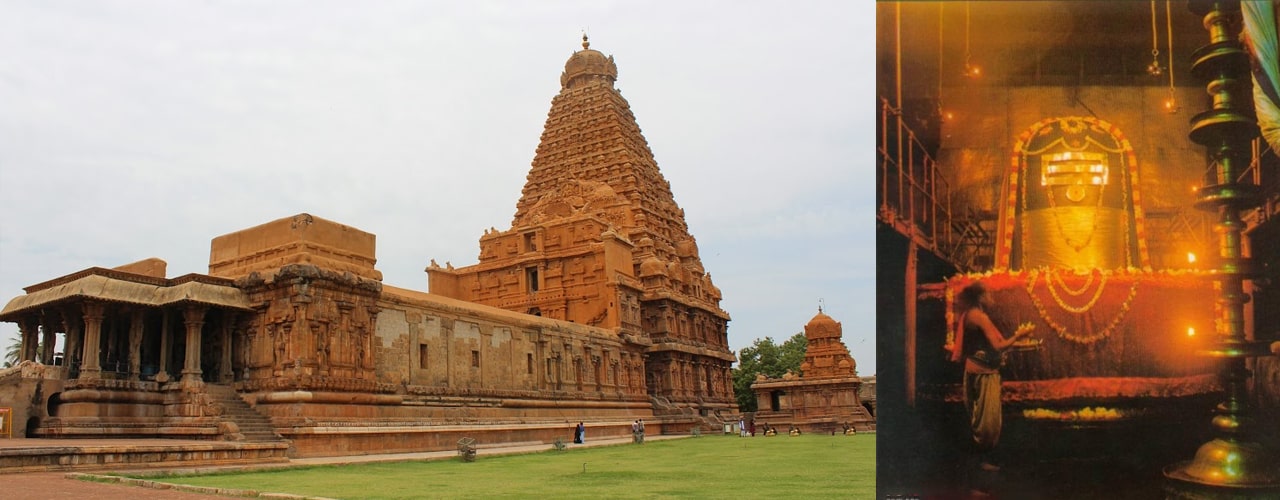
Brihadeeswara Temple, Thanjavur
Brihadishvara Temple, also called Rajarajesvaram or Peruvudaiyār Kōvil, is a Hindu temple dedicated to Shiva located in South bank of Kaveri river in Thanjavur, Tamil Nadu, India.It is one of the largest South Indian temples and an exemplary example of a fully realized Dravidian architecture.It is called as Dhakshina Meru (Meru of south).Built by Tamil king Raja Raja Chola I between 1003 and 1010 AD, the temple is a part of the UNESCO World Heritage Site known as the "Great Living Chola Temples", along with the Chola dynasty era Gangaikonda Cholapuram temple and Airavatesvara temple that are about 70 kilometres (43 mi) and 40 kilometres (25 mi) to its northeast respectively.
The original monuments of this 11th century temple were built around a moat. It included gopura, the main temple, its massive tower, inscriptions, frescoes and sculptures predominantly related to Shaivism, but also of Vaishnavism and Shaktism traditions of Hinduism. The temple was damaged in its history and some artwork is now missing. Additional mandapam and monuments were added in centuries that followed. The temple now stands amidst fortified walls that were added after the 16th century.
Built out of granite, the vimana tower above the sanctum is one of the tallest in South India.It was, in all likelihood, one of the tallest structures in the world at the time of its construction.The temple has a massive colonnaded prakara (corridor) and one of the largest Shiva lingas in India.It is also famed for the quality of its sculpture, as well as being the location that commissioned the brass Nataraja – Shiva as the lord of dance, in 11th century. The complex includes shrines for Nandi, Parvati, Kartikeya, Ganesha, Sabhapati, Dakshinamurti, Chandeshvara, Varahi and others.The temple is one of the most visited tourist attractions in Tamil Nadu.
The Brihadeshvara temple plan and development utilizes the axial and symmetrical geometry rules.It is classified as Perunkoil (also called Madakkoil), a big temple built on a higher platform of a natural or man-made mounds.The temple complex is a rectangle that is almost two stacked squares, covering 240.79 metres (790.0 ft) east to west, and 121.92 metres (400.0 ft) north to south. In this space are five main sections: the sanctum with the towering superstructure (sri vimana), the Nandi hall in front (Nandi-mandapam) and in between these the main community hall (mukhamandapam), the great gathering hall (mahamandapam) and the pavilion that connects the great hall with the sanctum (ardhamandapam).
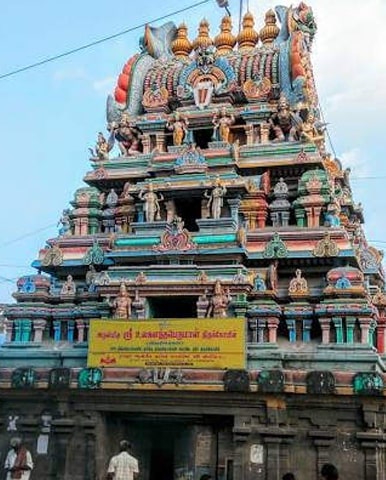
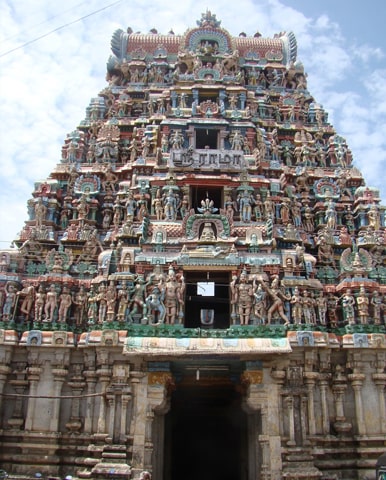
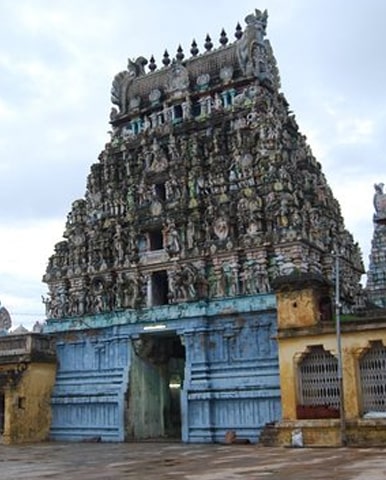
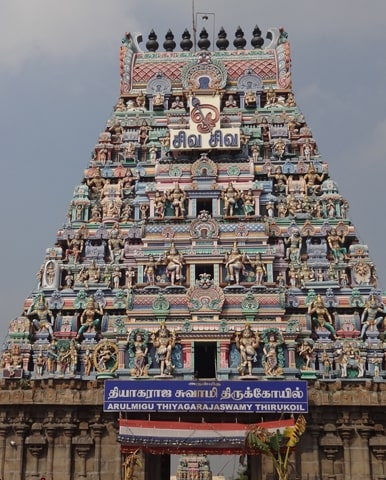
The temple complex integrates a large pillared and covered veranda (prakara) in its spacious courtyard, with a perimeter of about 450 metres (1,480 ft) for circumambulation. Outside this pillared veranda there are two walls of enclosure, the outer one being defensive and added in 1777 CE by the French colonial forces with gun-holes with the temple serving as an arsenal. They made the outer wall high, isolating the temple complex area. On its east end is the original main gopuram or gateway that is barrel vaulted. It is less than half the size of the main temple's vimana. Additional structures were added to the original temple after the 11th century, such as a mandapa in its northeast corner and additional gopurams (gateways) on its perimeters to allow people to enter and leave from multiple locations.Some of the shrines and structures were added during the Pandya, Nayaka, Vijayanagara and Maratha era, before the colonial era started, and these builders respected the original plans and symmetry rules. Inside the original temple courtyard, along with the main sanctum and Nandi-mandapam are two major shrines, one for Kartikeya and for Parvati. The complex has additional smaller shrines.
Source : Wikipedia
TrasnportBy Road: Thanjavur is well-connected to many cities of Tamil Nadu by road. National highways that pass through the city are NH 67, NH 45C, and NH 226. These highways connect the city to Tiruchirapalli, Coimbatore, Pudukottai and many more.
By Train: Thanjavur is connected to nearby places through railways but there are very few long distance trains. Superfast and fast mail and express trains along with Jan Shatabdi have stoppages here. For long distance trains, tourists can go to Tiruchirapalli where many long distance trains arrive.
By Air: Thanjavur does not have airport but the nearest airport is Tiruchirapalli from where flights to Indian and foreign cities can be caught. People who arrive at Tiruchirapalli can hire a taxi or take a bus to reach Thanjavur.