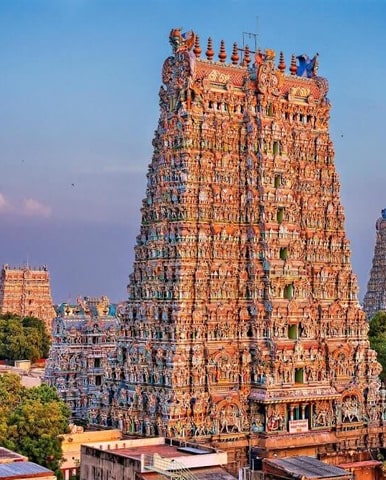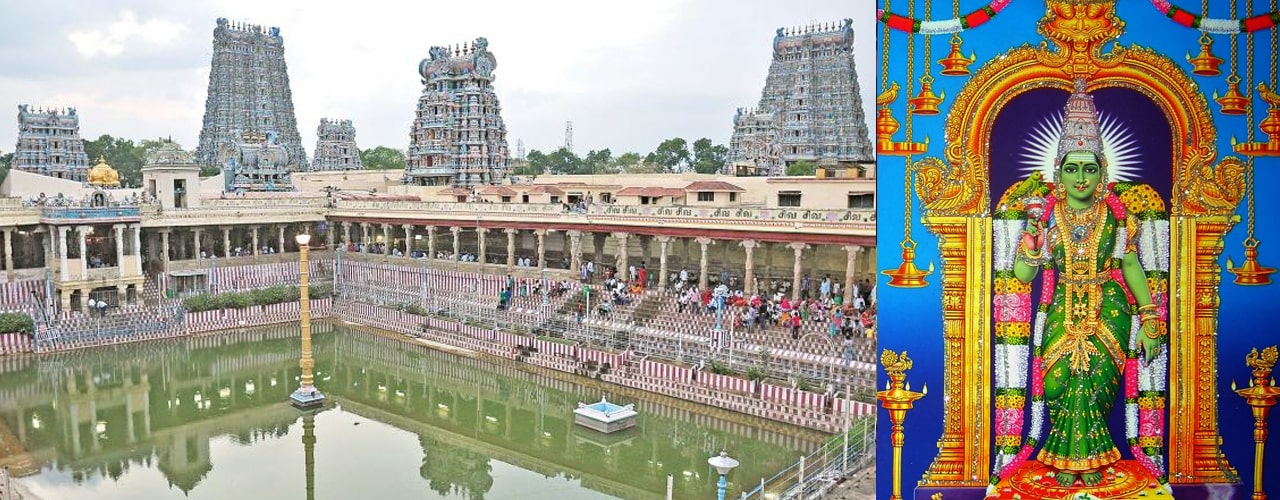
Meenakshi Amman Temple, Madurai
Meenakshi Temple (also referred to as Meenakshi Amman Temple or Meenakshi Sundareshwarar Temple also spelled as Meenaatchi Temple)is a historic Hindu temple located on the southern bank of the Vaigai River in the temple city of Madurai, Tamil Nadu, India. It is dedicated to Thirukamakottam udaya aaludaiya nachiyar (திருக்காமக்கோட்டம் உடைய ஆளுடைய நாச்சியார்) Meenakshi, a form of Parvati, and her consort, Sundareshwar, a form of Shiva.The temple is at the center of the ancient temple city of Madurai mentioned in the Tamil Sangam literature, with the goddess temple mentioned in 6th century CE texts.This temple is one of the Paadal Petra Sthalam. The Paadal Petra sthalam are 275 temples of lord Shiva that are revered in the verses of Tamil Saiva Nayanars of 6th-9th century CE.
Madurai Meenakshi Sundareswarar temple was built by King Kulasekara Pandya (1190-1216 CE). He built the main Portions of the three-storeyed gopura at the entrance of Sundareswarar Shrine and the central portion of the Goddess Meenakshi Shrine are some of the earliest surviving parts of the temple. The traditional texts call him a poet-saint king, additionally credit him with a poem called Ambikai Malai, as well as shrines (koil) each for Natarajar and Surya near the main temple, Ayyanar in the east, Vinayagar in the south, Kariamalperumal in the west and Kali in the north. He also built a Mahamandapam. Kulasekara Pandya was also a poet and he composed a poem on Meenakshi named Ambikai Malai.Maravarman Sundara Pandyan I built a gopura in 1231, then called Avanivendaraman, later rebuilt, expanded and named as Sundara Pandya Thirukkopuram.Chitra gopuram (W), also known as Muttalakkum Vayil, was built by Maravarman Sundara Pandyan II (1238-1251). This gopuram is named after the frescoes and reliefs that depict secular and religious themes of Hindu culture. Maravarman Sundara Pandyan II also added a pillared corridor to the Sundareswara shrine and the Sundara Pandyan Mandapam .
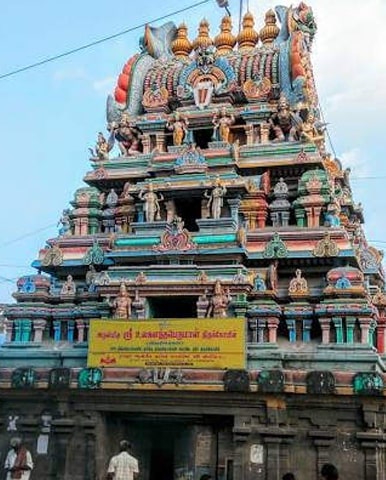
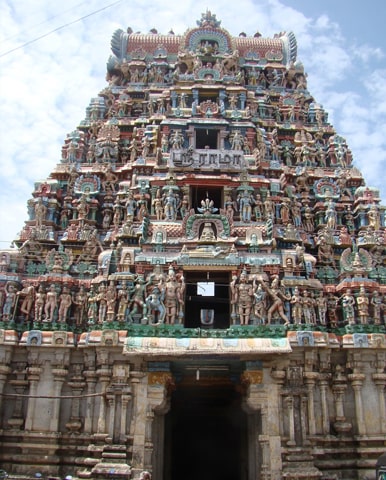
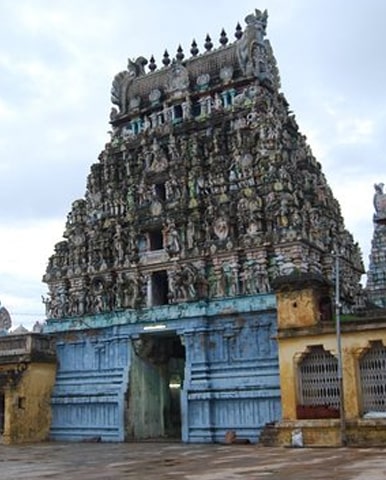
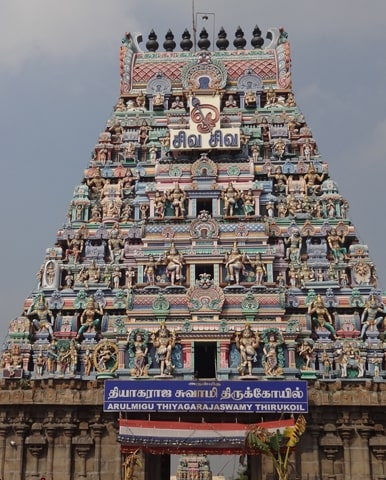
It was rebuilt after the 14th-century damage, its granite structure was renovated by Kumara Krishnappar after 1595 . Though the temple has historic roots, most of the present campus structure was rebuilt after the 14th century CE, further repaired, renovated and expanded in the 17th century by Tirumala Nayaka.In the early 14th century, the armies of Delhi Sultanate led by Muslim Commander Malik Kafur plundered the temple, looted it of its valuables and destroyed the Madurai temple town along with many other temple towns of South India. The contemporary temple is the result of rebuilding efforts started by the Vijayanagara Empire rulers who rebuilt the core and reopened the temple.In the 16th century, the temple complex was further expanded and fortified by the Nayak ruler Vishwanatha Nayakar and later others. The restored complex now houses 14 gopurams (gateway towers), ranging from 45–50m in height, with the southern gopura tallest at 51.9 metres (170 ft). The complex has numerous sculpted pillared halls such as Ayirakkal (1000-pillared hall), Kilikoondu-mandapam, Golu-mandapam and Pudu-mandapam. Its shrines are dedicated to Hindu deities and Shaivism scholars, with the vimanas above the garbhagrihas (sanctums) of Meenakshi and Sundaresvara gilded with gold.
The temple is a major pilgrimage destination within the Shaivism tradition, dedicated to Meenakshi Devi and Shiva. However, the temple includes Vishnu in many narratives, sculptures and rituals as he is considered to be Meenakshi's brother.This has made this temple and Madurai as the "southern Mathura", one included in Vaishnava texts.The Meenakshi temple also includes Lakshmi, flute playing Krishna, Rukmini, Brahma, Saraswati, other Vedic and Puranic deities, as well as artwork showing narratives from major Hindu texts. The large temple complex is the most prominent landmark in Madurai and attracts tens of thousands visitors a day.The temple attracts over a million pilgrims and visitors during the annual 10-day Meenakshi Tirukalyanam festival, celebrated with much festivities and a ratha (chariot) procession during the Tamil month of Chittirai (overlaps with April–May in Georgian calendar, Chaitra in North India).The Temple has been adjudged best ‘Swachh Iconic Place’ in India as on October 1, 2017 under Swachh Bharat Abhiyan.
The town of Madurai is ancient and one mentioned in Sangam era texts.These are dated to be from the 1st to 4th century CE.Some early Tamil texts call Madurai as Koodal, and these portray it as a capital and a temple town where every street radiated from the temple. Goddess Meenakshi is described as the divine ruler, who along with Shiva were the primary deities that the southern Tamil kingdoms such as the Pandya dynasty revered.The early texts imply that a temple existed in Madurai by the mid 6th century.In medieval literature and inscriptions, it is sometimes referred to as Kadambavanam (lit. "forest of Kadamba") or Velliambalam (lit. "silver hall" where Shiva danced). It was described to be the sangam of scholars, or a place where scholars meet. It is mentioned in the Tamil text Tiruvilayadalpuranam and the Sanskrit text Halasya Mahatmya.It is one of the shrines of the 275 Paadal Petra Sthalams.
Source : Wikipedia
TrasnportBy Road: Madurai is situated on National Highways NH-7, NH-45B, and NH-49. Almost all of them are presentlybeing upgraded to multi-lane ways as part of National highway development program. Travel fromChennai and Bangalore will take approximately 8-10 hours.
By Train: Trains are the major mode of entry into the city. The railway station is centrally located and manyfacilities are accessible from there. Madurai is well connected by trains to many parts of Indialike Chennai, Bangalore, Mumbai (Bombay), and Delhi.A train journey from Chennai takes 8 to 10 hours and is the preferred railhead. Train tickets can bebooked from Indian Railways' reservation centers or online from IRCTC.
By Air: Madurai has an International / Domestic airport with fairly good facilities. The flights connect mainlyto Chennai (Madras), but there are few direct flights to other major Indian cities.The airport is about 15 km from the city center off National Highway 47. It is best to hire a taxi from theairport from the counter in the arrival lounge or arrange for someone to meet you at the airport. Forthose who prefer to use public transport, you should take bus number 10A, which runs from the airportto the Periyar bus stand.